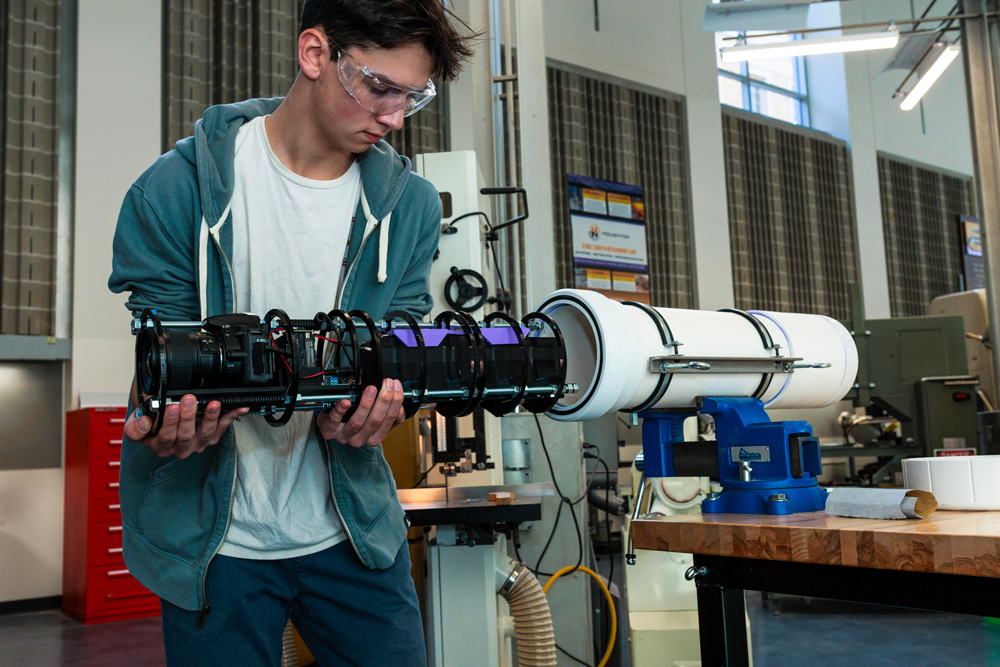
UW–Madison junior Soren Goldsmith wears a lot of hats. The FP&M photography intern and geological engineering major is also a longtime wildlife photographer, and a National Geographic Explorer. Soren has always been driven to capture images no one has ever seen before.
“I started thinking more long-term about how I can merge these two interests of mine,” he said.
That line of thinking eventually led him to a project that brings engineering innovation, environmental awareness, and photography together in a compelling way.
Growing up in Lexington, Massachusetts, Soren often explored the nearby New England salt marshes, ecosystems that many may dismiss.
“People often associate [salt marshes] with wasteland areas,” he said.
But Soren soon learned they’re one of the most biodiverse ecosystems in Massachusetts, capable of storing carbon more densely than a tropical forest would and protecting coastal communities from eroding into the ocean.
Despite their importance, projections show this important ecosystem could disappear by the end of the century because of human development and sea level rise. This urgency motivated Soren to bring attention to these overlooked environments through photography.
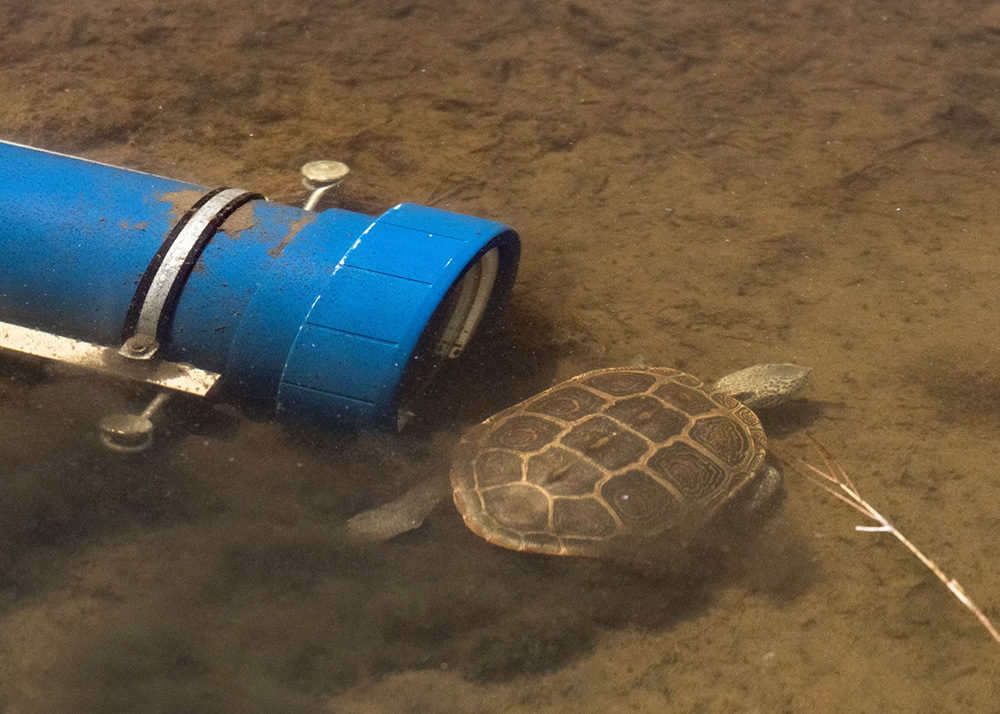
But photographing salt marsh wildlife isn’t simple. Traditional infrared camera traps won’t work underwater because the water obscures it. To capture animals like fish and turtles, Soren realized he would need a new kind of sensor, which didn’t exist.
Soren and the UW-Madison chapter of Engineers for a Sustainable World decided to build a completely new, long-lasting camera system capable of surviving harsh marsh conditions. They designed the enclosure and software that powers the camera — making the equipment fully waterproof, compact enough to fit in a small form factor, and durable enough to withstand weeks in the marsh.
The result: a first-of-its-kind camera trapping to capture scenes scientists and photographers have never been able to document. For Soren, this project is only the beginning.
“Long term, I think I can make a greater impact by getting tools that I build into the hands of more people,” he said.
Researchers are already expressing interest. Some have told him current methods for surveying fish rely on intrusive techniques like electrofishing, making his camera a meaningful alternative. Even for photographers, the camera offers a new window into the underwater world more efficiently.
While the engineering challenge was immense, Soren’s favorite part is seeing others inspired by the concept.
In addition to his engineering and conservation work, Soren plays a major visual role at FP&M as a photography intern with the Marketing and Communications team. His primary responsibility is documenting UW-Madison construction and infrastructure for Universities of Wisconsin Board of Regents meetings. This means traveling across campus, capturing the progress of major projects, and helping tell the story of the university’s evolving built environment. His other assignments include FP&M marketing and communications initiatives, such as “What’s Your Job?” features, leadership site visits, and the annual Biosafety Month content, where he documents safe lab practices for educational materials.
Jake Stottler, Multimedia Designer for FP&M, is Soren’s supervisor and described him as a great asset to the division.
“Soren gives written stories a depth of personality through his photography,” said Jake. “His expertise enables FP&M to expand our media assets – in scope and quality – for projects.”
Though his underwater engineering project isn’t directly tied to FP&M, both experiences reflect his ability to use photography to make unseen work visible, whether that is biodiversity below the waterline or the infrastructure supporting UW–Madison’s campus. His projects, whether rooted in conservation or campus infrastructure, share one mission: helping people see the value of the spaces and systems that shape their lives.
Read more about Soren and his work in the UW-Madison College of Engineering newsletter.
By: Ashley Barrera and Maya Morvis
Ashley is a strategic communications student intern with FP&M Marketing & Communications. She is a fourth-year at UW-Madison majoring in Journalism on the strategic communications track. Ashley has been working at FP&M since spring of 2025.
Maya is a strategic communications intern with FP&M Marketing & Communications. She is a third-year at UW-Madison studying Journalism on the strategic communications track and Political Science. Maya has been working at FP&M since August 2025.