What’s your job? is a series focused on the work of FP&M employees. As the largest and most diverse nonacademic unit on campus, it can be challenging to learn everything our division is responsible for. These stories shine a light on FP&Mers and what they do to keep campus safe, sustainable and successful.

You may not see Mari Lynn Haugh in-person on campus every day, but you definitely see her work. As a Floor Plan Specialist in the Space Management Office (SMO), Mari Lynn is the invisible navigator behind many campus room numbers, wayfinding signs and evacuation maps, helping make UW–Madison’s sometimes complex spaces easier to understand and traverse. She assigns and reassigns campus room numbers, from classrooms, to stadiums, to dorms, and everything in between.
One of the longest-tenured members of SMO, Mari Lynn arrived at UW-Madison in 2000. Back then there were far fewer staff members, so she wore many hats. Mari Lynn contributed to the university’s first web-based campus maps and played a key role in standardizing and promoting official names for buildings and locations that were often referred to differently across campus. A memorable early project for Mari Lynn was creating wayfinding maps for Bascom Hall, Birge Hall, Law, Education, and Grainger buildings.
“I enjoyed that because I got to work directly with people and help them find where they’re going,” Mari Lynn said.
Mari Lynn considers herself a “Jack of all trades,” and as such, a typical day often lives up to that label. On any given day, she can be found updating room numbers and floor plans, doing a walkthrough of a facility, or meeting with the SMO team, other departments or customers.
Every room has a number. Every number makes sense.
A room’s number may seem insignificant, but as Mari Lynn explained, they are vitally important when helping people get around campus. Whether it’s a student finding their lecture hall, a vendor making a delivery, staff coordinating building maintenance, or a first responder, everyone benefits when room numbers make sense!
“Who knew that somebody assigned room numbers until you can’t find a space in the building? I’m kind of this baseline.” Mari Lynn said. “I care that it’s valuable to the people who use it. It is not particularly glamorous but extremely functional.”
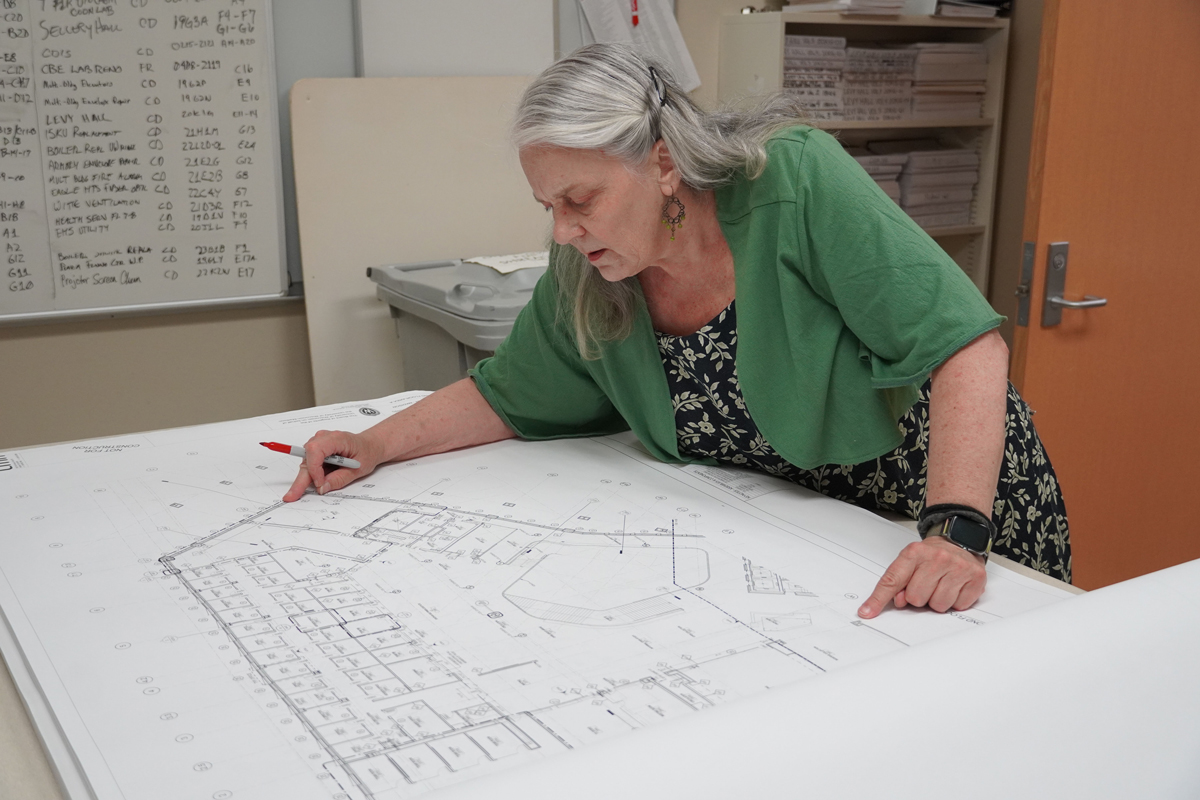
According to Mari Lynn, room numbers are most helpful when they help communicate a unique location. This can include using the first digit to indicate the floor or arranging numbers in a sequence that helps direct people through a space. The intention is to number all building rooms from the perspective of how a person travels.
“You want the numbers to decrease or increase in one direction so you can find where you are,” she said. “We try to make Room 1262 be in the same place as 2262, one floor up.”
Some building rooms received numbers over 150 years ago, while others were numbered within the last few months. Whether new buildings are added or older buildings are renovated to add or remove rooms, all of this can have an impact on room or building numbering. Keeping things up-to-date and navigable can be a challenge on a campus the size of a small city.
When new construction plans come in, Mari Lynn updates floor plans and room data in a consistent, standardized way. In many cases, projects are still in progress, and the floor plans haven’t been numbered yet. That’s where Mari Lynn comes in. She has a knack for numbering rooms, making sure every space with a door has a number, and every number makes sense.
“There are very few places, or cities, that have this consistency of room numbering,” Mari Lynn said. “So it’s pretty amazing that we do.”
Safety in numbers.
Room numbers are also an integral part of campus safety.
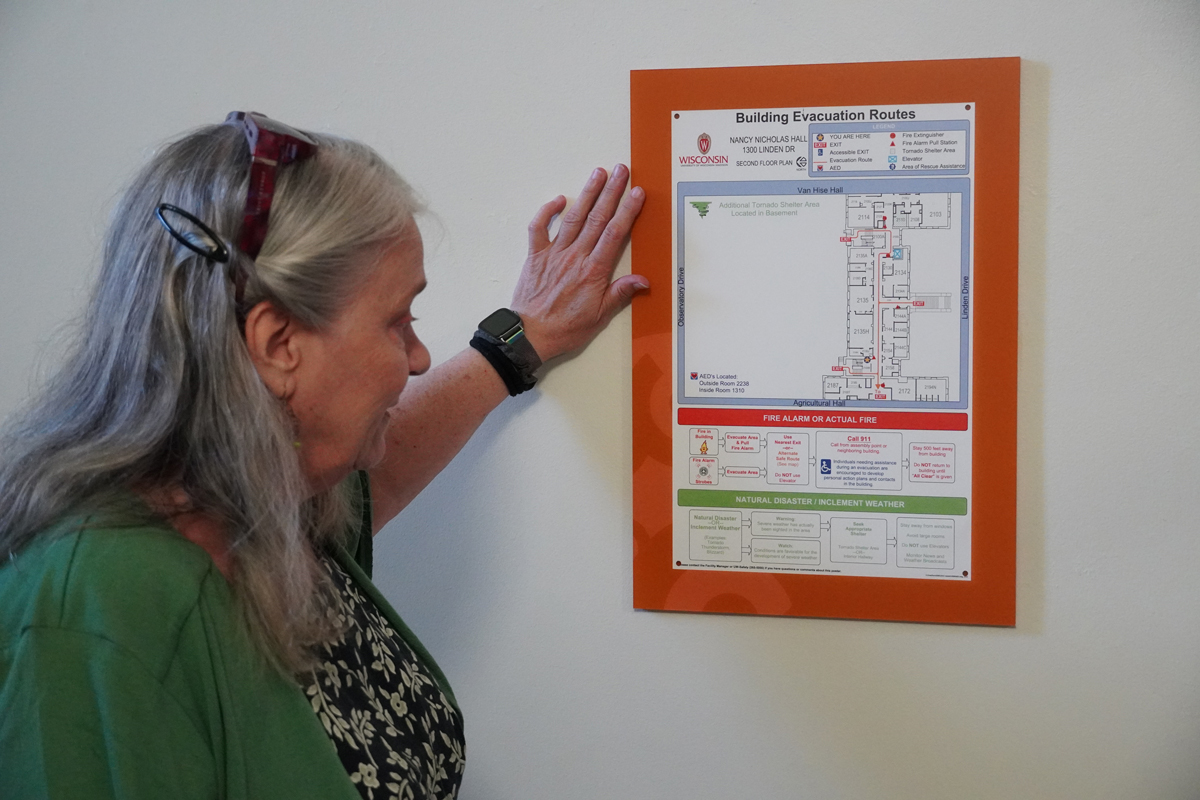
In 2005, Mari Lynn helped develop the university’s official evacuation route posters that direct people to the nearest way out of buildings. At the time, the UW-Madison Police Department and FP&M’s Environment, Health & Safety (EH&S) were trying to combine several safety posters into one to make it easier to find and also reduce visual clutter. Jeff Schiller at EH&S Fire & Life Safety asked for Mari Lynn’s help. She set up a template, which is still used today.
These building-specific posters are hung on each floor so occupants can view the closest exits, egress routes, fire extinguishers, fire alarm pull stations, Areas of Rescue Assistance, accessible exits and in-place tornado shelter areas. Mari Lynn still maintains the maps and numbering of each location while Fire & Life Safety adds the safety guidance.
“I had surgery [around that time], and when I came back, there was an evacuation poster customized from my chair [to the evacuation routes from that spot]. Mari Lynn said proudly. “My evacuation poster! It was really sweet that Jeff did that for me.”
Making the most of the space.
SMO collects, maintains and analyzes space data for the entire campus and all UW-Madison properties, and as the number of people on campus rises, available space is shrinking fast.
“Space has become much more of a commodity than it was.” Mari Lynn said.
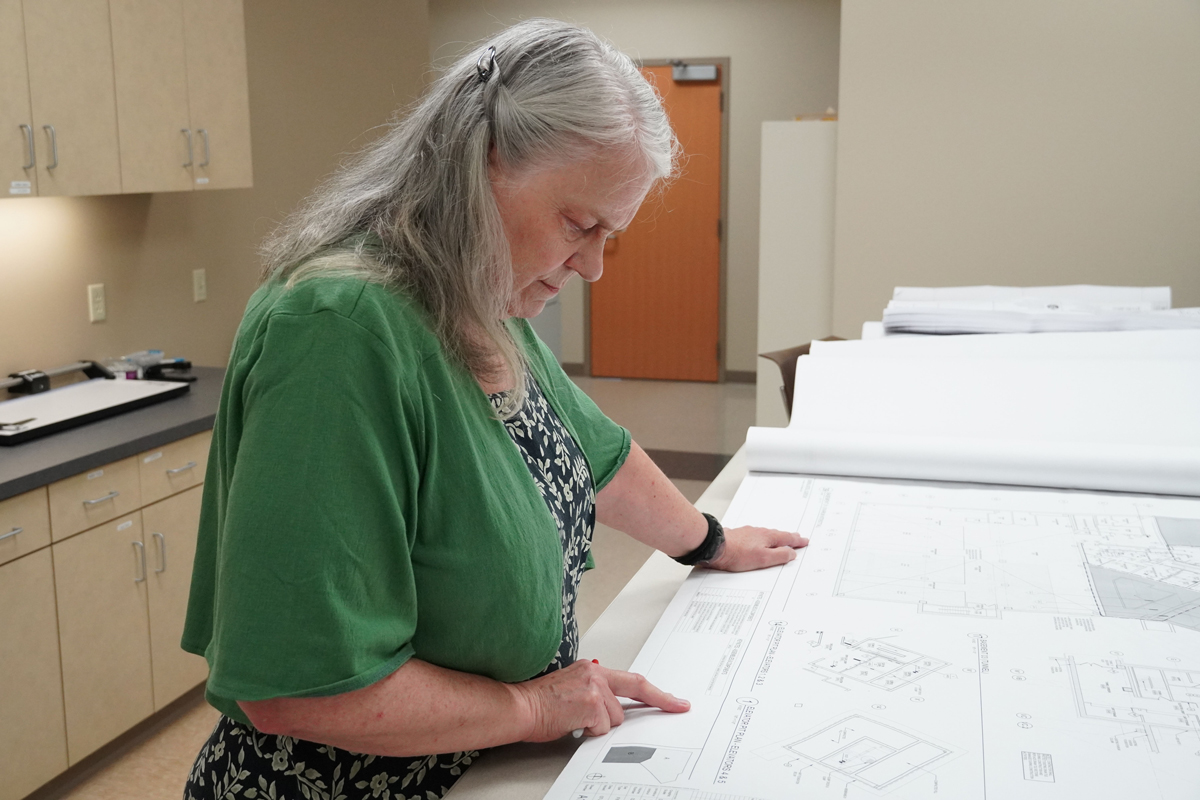
The office had already digitized floor plans by the time Mari Lynn joined. The unit was tied to a database way back in the `90s, something Mari Lynn noted was very progressive for its time. Mari Lynn continued the momentum by expanding SMO’s space information, collaborating with her teammates and many campus customers to do so. As a result, SMO has been able to make more data-driven decisions over time that maximize space use.
“We’ve gotten way more coordinated and efficient across campus units,” she added.
Thriving in teamwork.
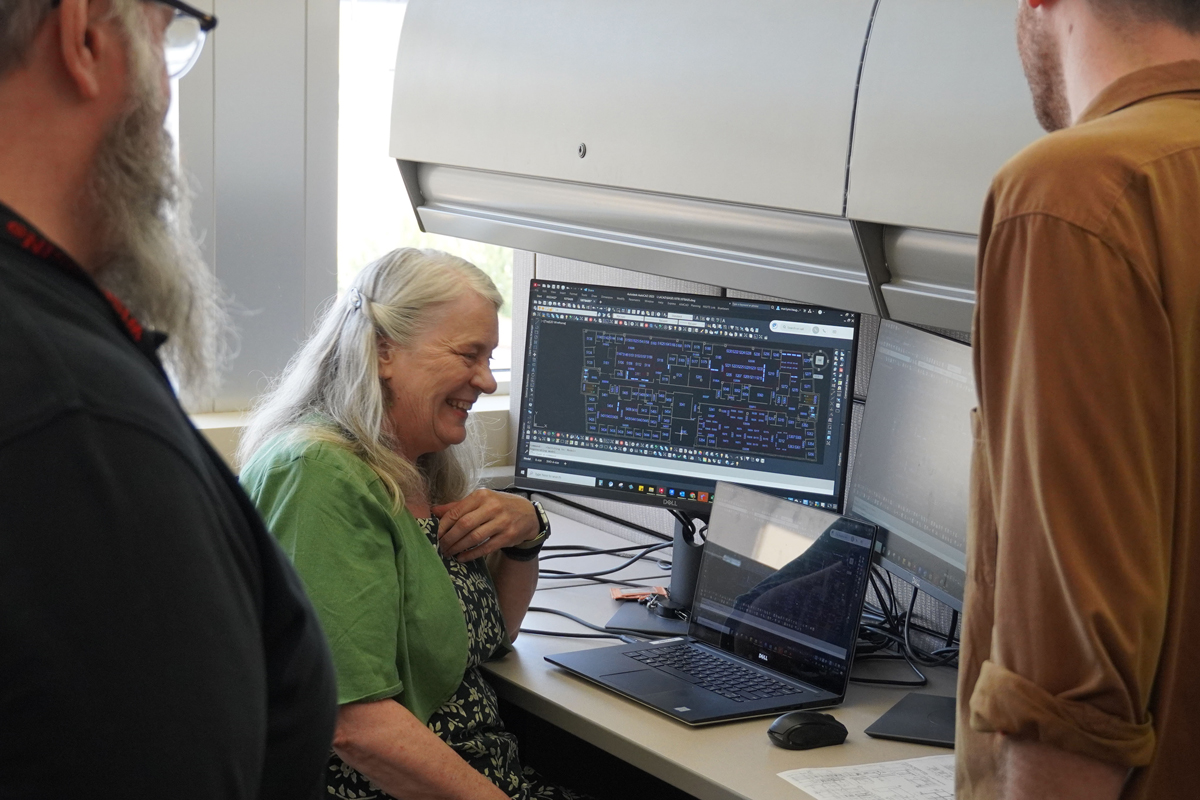
Mari Lynn believes that being creative and thorough alongside her proactive teammates has been the key to success, adding it takes a village to manage the space of this “mini city.”
“It isn’t just me, it’s the whole group who makes it happen,” Mari Lynn said.
So the next time you find your destination while navigating a new building, look for the subtle signs from Mari Lynn and SMO that helped you get there. Thanks to their team, every number adds up to a smoother journey across campus.
Want to learn more about the Space Management office? More information is available on the Space Management web page. You can get in touch with Mari Lynn at marilynn.haugh@wisc.edu.
For more on evacuation route maps and safety, refer to the Environment, Health & Safety Exit and Evacuation web page.
by Kate Reuscher
Kate Reuscher was a strategic communications student intern with FP&M Marketing & Communications. She is a junior at UW-Madison majoring in Journalism and Strategic Communication with a certificate in Digital Media Analytics and Digital Studies. Kate worked at FP&M in 2024.