When the Madison Fire Department (MFD) wanted hands-on training for a potential radiation emergency, they turned to UW–Madison, with whom they had a long-standing relationship, for help.
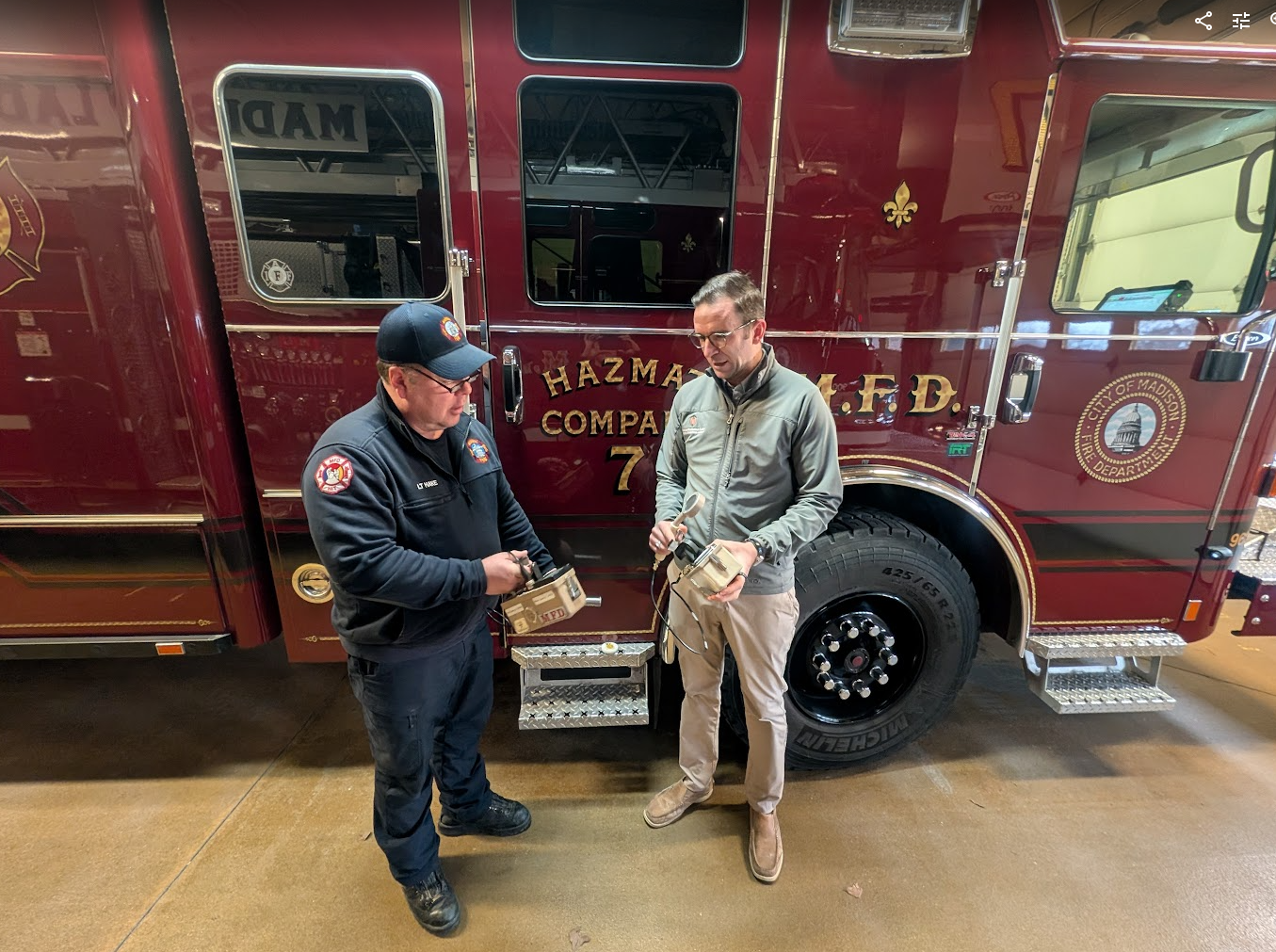
Last fall, Associate Radiation Safety Officer Jason Rusch with FP&M Environment, Health & Safety (EH&S), partnered with state agencies and local firefighters to deliver innovative, in-depth radiation safety training. The collaboration gave firefighters practical experience with scenarios they are unlikely to encounter, but must be prepared for.
For Jason, the work reflects FP&M’s — and the entire university’s — commitment to the safety and well-being of the broader Wisconsin community. Radiation isn’t something most Wisconsinites think about, but that’s exactly the point. While the public goes about daily life, experts work quietly behind the scenes to ensure radiation never becomes a threat. That unseen labor, rooted in partnerships with state agencies and local first responders like the Madison Fire Department, reflects the Wisconsin Idea in action.
MFD’s hazardous materials team responds to chemical spills, unknown substances and industrial accidents across the city. But until this fall, radiation safety wasn’t something they received much hands-on training for.
That changed when MFD Station 7’s hazmat lieutenant reached out to Jason and EH&S’s Office of Radiation Safety for help. The firefighters knew that if a radiation-related emergency occurred in Madison, it would almost certainly involve the university, its research labs, its radioactive materials, or its medical facilities.
“They told us their knowledge of radiation was limited,” Jason said. “But what surprised me most was how eager they were to learn. They weren’t being forced into training; they genuinely wanted to be better at their jobs.”
In response, Jason coordinated with Charles Adams from the Wisconsin Department of Health Services and Bob Agasie at UW’s nuclear reactor to design a three-part, collaborative training unlike anything the firefighters had experienced before.
Each agency brought its strengths:
- The State of Wisconsin provided regulatory expertise: the laws, rules, and best practices that govern radioactive materials.
- The UW Nuclear Reactor offered a rare chance to see a functioning research reactor up close, demystifying a facility that most people only hear rumors about.
- UW’s Radiation Safety Office supplied real-world experience: the day-to-day incidents, the lab practices, and the actual radioactive materials used to simulate emergency conditions.
Together, the coalition created a full-scale training that blended classroom learning, hands-on practice at the reactor; and a complex, UW-designed emergency scenario simulating a major traffic accident involving radiation. Firefighters navigated a mock overturned SUV containing radioactive cargo, a burned semi-truck scenario, and contamination-control practice stations.
Jason said the firefighters needed a realistic situation that tested their decision-making, not their ability to memorize facts. In the final phase of training, firefighters walked into a debris field created inside UW’s hazardous waste facility. Real radioactive sources, safely controlled, were hidden around the space. Firefighters used handheld meters to locate, identify, and assess them just as they would in an actual emergency.
Jason said the range of knowledge among the 40 firefighters was wide. But all of them asked engaged, thoughtful questions.
“There’s nothing worse than giving radiation safety training and having the room be absolutely quiet,” he said. “They wanted to understand. They wanted to get it right.”
For Rusch, the biggest impact of the training is confidence. These firefighters can now respond to radiation-related 911 calls with better knowledge of what steps to take, what to prioritize and when to call UW or state experts for help.
“Life-saving measures always come first,” Jason emphasized. “They know that now, and they know how to handle the radiation afterwards.”
Jason said the training is a reminder that the university’s impact doesn’t end in Madison; it radiates outward through partnerships, preparedness and a shared understanding that Wisconsin is safest when its institutions learn from one another.
Want to learn more about the Environment, Health & Safety department at FP&M? More information is available on the EH&S Radiation Safety webpage. You can get in touch with Jason Rusch at jason.rusch@wisc.edu.
by Maya Morvis
Maya was a strategic communications student intern with FP&M Marketing & Communications. She is a junior at UW-Madison majoring in Journalism and Political Science with certificates/minors in Digital Studies and Science Communication. Maya worked at FP&M during Fall Semester 2025.